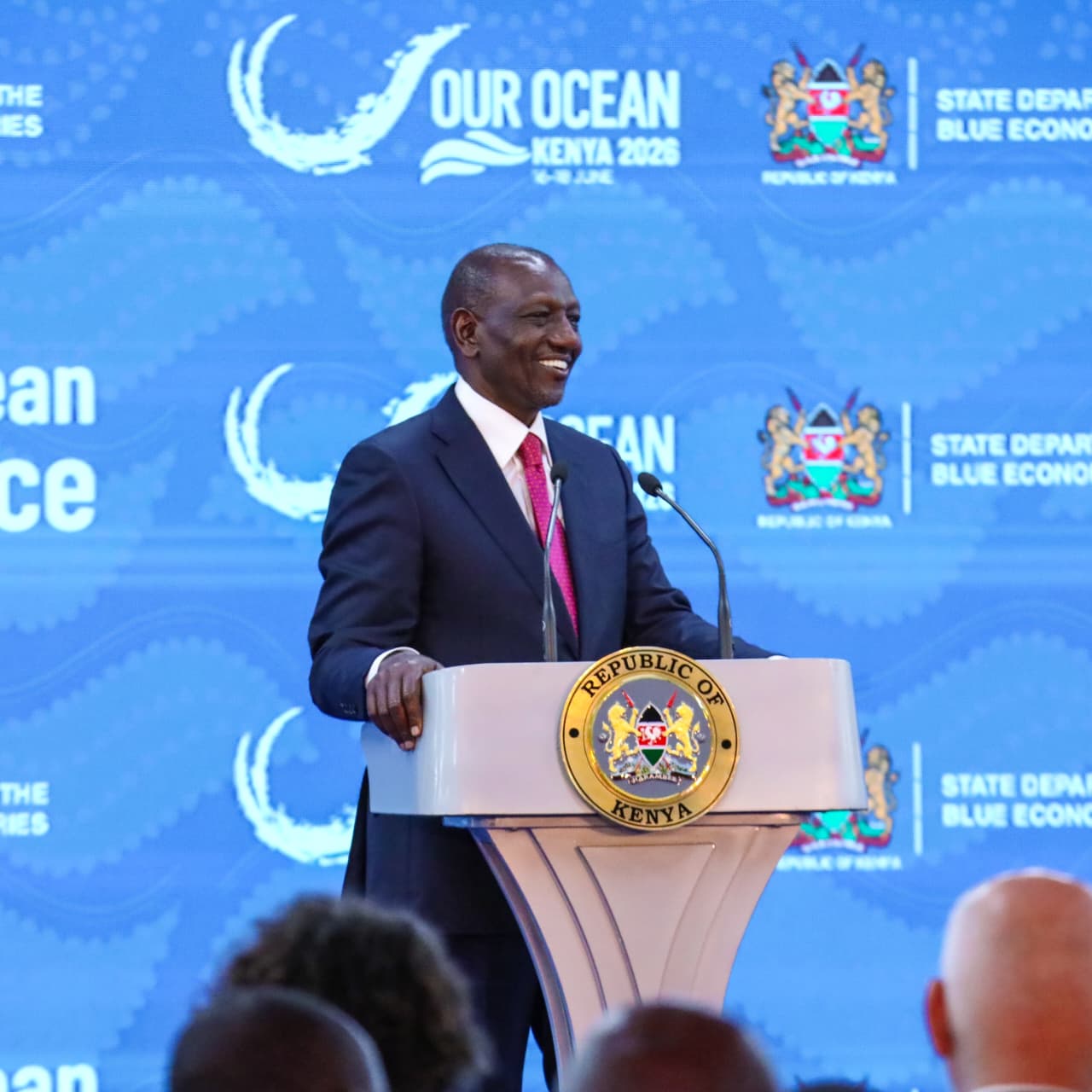
H.E. President William Ruto has urged global leaders and delegates to take bold steps and turn promises into tangible action as he presided over the closing ceremony of the 11th Oceans Conference.
President Ruto said countries must find bolder ways to mobilise finance, harness technology and innovation, strengthen capacity, and accelerate the implementation of shared commitments.
The ceremony marked the end of a high-level global forum where countries renewed their commitments to ocean conservation.
The summit culminated in the adoption of the Mombasa Declaration of June 2026, which recorded 300 new commitments and pledges for ocean protection initiatives.
These commitments underscore growing global momentum to safeguard marine ecosystems amid rising climate and security concerns.
Kenya emerged as a key player at the conference, making 50 commitments worth Sh1.1 billion dollars to advance the blue economy, strengthen fisheries management, and enhance marine protection.
President Ruto further highlighted several measures Kenya has taken to promote sustainable ocean governance.
He cited initiatives such as the creation of a dedicated State Department for the Blue Economy and Fisheries, the construction of the Sh2.6 billion Shimoni Fish Port by Kenya Ports Authority, and the acquisition of patrol boats to strengthen maritime security.
The conference, which began on Tuesday, brought together more than 6,000 delegates from 104 countries and institutions, giving governments, scientists, and stakeholders a platform to turn policy commitments into concrete action on ocean protection.
The coastal city of Mombasa became the epicentre of global maritime governance during the conference marking the first time the premier forum has convened on African soil.
With the weight of a continent’s blue economy aspirations on its shoulders, the event, themed “Our Ocean, Our Heritage, Our Future,” shifts the international dialogue from abstract environmentalism to the tangible intersections of culture, commerce, and survival.
Deputy President Prof. Kithure Kindiki opened the conference on behalf of His Excellency the President Dr William Ruto on the first day. He was accompanied by cabinet secretaries and senior government officials, described the ocean as more than an ecological asset. He described it as a cornerstone of national identity and a vital anchor for regional stability, warning that its degradation poses risks extending far beyond the shoreline.
Additionally, the Deputy President underscored the economic urgency driving the conference, pointing to the Port of Mombasa as a critical lifeline for the East African hinterland.
He said the port remains central to the region’s economic integration, sustaining livelihoods and facilitating trade across multiple countries.
“Every container handled at the Port of Mombasa is not just a logistical statistic it represents livelihoods and connects millions of people across East Africa,” he said.
However, Prof. Kindiki warned that these economic gains are under growing threat from a range of environmental challenges.
He cited rising sea temperatures, illegal fishing, marine pollution and the rapid loss of biodiversity as key concerns that require immediate and coordinated intervention.
The Deputy President said the government has adopted a multi-pronged strategy to address these challenges and protect the country’s marine resources.
The approach includes large-scale mangrove restoration programmes, intensified ocean clean-up efforts, and sustained lobbying for access to global blue financing mechanisms.
“These measures are aimed at ensuring that our oceans continue to support economic growth while remaining sustainable for future generations,” he said.
The conference is structured to bridge the persistent gap between policy pledges and physical outcomes. Over the coming days, a coalition of government leaders, private sector executives, innovators, shipping and maritime stakeholders will work to move the global ocean agenda from dialogue to delivery.
The focus is sharply trained on placing jobs, equity, and ecosystem health at the heart of international cooperation, aiming to catalyse direct investment into the sustainable blue economy.
Parallel to these national efforts, the forum will advance collaborative strategies to combat illegal, unreported, and unregulated fishing while scaling marine conservation and restoration projects that yield verifiable results.
Former U.S. Secretary of State and founder of the Ocean Initiative, John F. Kerry, delivered a stark reminder to delegates, asserting that the ocean can no longer be an afterthought in climate policy. He stressed that this assembly must serve as the inflection point where commitment solidifies into implementation.